

Moriah Bailey
Bio:
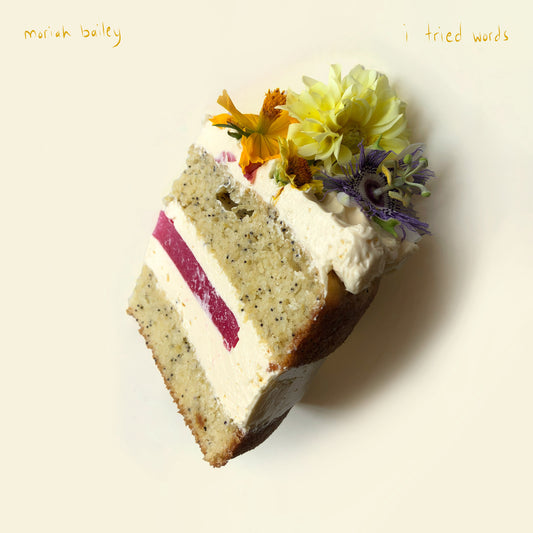
“i tried words" is held together by words, their limits, their potential, their weight. The album is in part a reflection on being taught that it is impolite to say no and/or moments when Moriah Bailey said no and her no was violated. The album sits with the experience of speaking and not being heard, experiences of abuse, and how those experiences influence relationships with the self, with romantic partners, with friends, with jobs. Within that, the album explores definitions and expectations of womanhood and femininity. Moriah Bailey plays the harp, an instrument strongly associated with notions of purity and femininity. Much of Bailey’s approach to the harp - looping, layering, playing with ambiance, dissonance, and noise - has implicitly challenged many of these assumptions about her instrument. “i tried words” relies less on experimental sounds, and instead, lyrically focuses on Bailey’s struggles to understand and make sense of definitions and expectations of femininity. The album explores these themes through an intimate narrative of losing oneself in a relationship and struggling to find a way out of the relationship. On its surface, it is an album about falling for and leaving the idea of what a relationship could be. Dig deeper, and the album is about breaking patterns, collecting strength, navigating mental health struggles, trusting oneself, complicating dualities, and learning to embrace both yes and no.
Moriah Bailey grew up in Oklahoma. She is the daughter of a lesbian, leftist, liberation theology-influenced pastor/activist mother and a rural, conservative, creative and animal-loving father. Her parents divorced when she was 5 years old, and she spent much of her childhood in cars, shuttling back and forth between Oklahoma City, Stillwater, and the small town where her grandparents lived. Her family extended beyond her parents and their biological families; her family included the LGBTQ community that made up her mother’s church, women her mother dated, and people who lived with her family because they needed a place to go. Her first memories of live music were watching local, folk songwriters perform at coffee shops, community events, or protests. Bailey loved that music; it was clever, witty, personal, political, direct. Bailey’s music draws on these early influences but tends to be more indirect and metaphorical. This approach is evident on the standout track, “the ocean life,” a song that can be interpreted in multiple ways but alludes to and references notions of freedom, environmental degradation, capitalist consumption, and/or longing for a different kind of life.
The album contains multiple layers and themes. It explores dualities: yes/no, future/past, darkness/light, giving/taking, masculinity/femininity, wants/needs. The album is in part about Moriah Bailey’s struggle to learn healthy boundaries but also about the harmfulness, complexity, and entanglement of many social boundaries. Explorations of femininity most clearly emerge in the songs “a late spring” and “my mother’s words.” Bailey sings “I will rise and exceed your expectations of she ‘cause I refuse to carry all the things you put on me: Woman, Mother, Lover, Bird. My song lingers unheard. Left here repeating my mother’s words: you can never say yes if you can’t say no.” Bailey deeply resented femininity and the expectations that she associated with it. The album illuminates Bailey’s struggle to embrace femininity both within and against imposed expectations. Further, the album is in part about Bailey making peace with her own relationship to femininity, something that once felt (and sometimes still feels) very uncomfortable and harmful to her.
“i tried words” began with words, mostly words. Moriah Bailey laid the lyrics out on several pages. The words were crafted over many months with feedback from Bailey’s sister and input from the growing melodies and body of music that began to take shape around those words. Bailey knew as she was writing the album that she wanted to include more instrumentalists in the recording process. In part, she wanted a fuller and more familiar sound. In Bailey’s last recording, every sound on the album was created with harp, effects pedals, and voice. She wanted this album to evoke a different sound and feeling. Bailey began recording the album in 2020. Harp and vocals were recorded in Bailey’s former rental home in Tucson, AZ over the span of several months. Once the harp was finalized, she identified several musicians whose work she trusted, cherished, and valued to contribute to the album: Sarah Reid (violin), Ryan Robinson (percussion), and Ricky Tutaan (guitar). The contributing musicians resided in either Arizona or Oklahoma, each musician recorded their own parts and sent them to Bailey. Bailey drafted chord charts with general guidance for each track, but she mostly wanted the musicians to add in the ways that felt organic and supportive of the harp and vocals. Each musician added their own parts based on their musical intuition and insight. Bailey then made some very minor edits before sending the tracks to Chris Harris of Harrilon Media for mixing and mastering.
The final song on the album “not staying” is a triumphant goodbye and joyous new beginning. As Moriah Bailey refuses to continue stretching herself to her limits to appease someone else. In the context of the album, the song is about embracing no to some things and yes to others. She sings “I contorted my body and stretched myself thin to form a bridge between now and when. so, as I'm gathering my strength to say goodbye, please quit saying I should've tried.”
-
Moriah Bailey (fka sun riah) - i tried words
Regular price $10.00 USDRegular priceUnit price per$10.00 USDSale price $10.00 USD -
Moriah Bailey (fka sun riah) - Sitting with Sounds and Listening for Ghosts
Regular price From $6.00 USDRegular priceUnit price per